Hiéroglyphe égyptien A18
| Hiéroglyphe égyptien A18 | |||
| Représentation |
|
||
|---|---|---|---|
| Classification | section A : « L'Homme et ses occupations » |
||
| code Gardiner | A18 | ||
| Unicode | A018 | ||
| Translittération | ḫr ou ḫrw | ||
| Utilisation | déterminatif | ||
| Couleur | |||
| Classement | |||
| Précédent | Hiéroglyphe égyptien A17 | ||
| Suivant | Hiéroglyphe égyptien A19 | ||

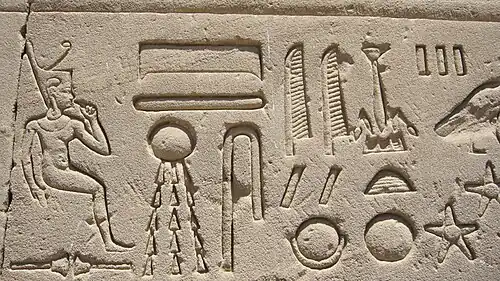
Le hiéroglyphe égyptien A18 (pharaon enfant) est classifié dans la section A « L'Homme et ses occupations » de la liste de Gardiner ; il y est noté A18.
Représentation
Il représente un enfant assis portant un doigt de sa main droite à la bouche et le bras gauche pendant (hiéroglyphe A17) portant la couronne « dšrt » de Basse-Égypte (hiéroglyphe S3). C'est donc un pharaon enfant.
Utilisation
C'est un déterminatif de quelques mots qualifiant un enfant particulier.
Exemples de mots
|
|
| ||||||||||||
| jmt(y) | jnpw | wḏḥ | ||||||||||||
| nc- émule, enfant adoptif | nc- enfant royal | vb- sevrer
nc- enfant sevré |


Notes et références
Bibliographie
- Alan Henderson Gardiner, Egyptian Grammar: Being an Introduction to the Study of Hieroglyphs, [détail des éditions] (lire en ligne).
- Pierre Grandet, Bernard Mathieu, Cours d'égyptien hiéroglyphique [détail des éditions].
- Raymond Oliver Faulkner et Association Medjat, Dictionnaire Faulkner / Medjat (Dictionnaire en ligne), Projet Rosette / Griffith Institute (lire en ligne).
 Portail de l’Égypte antique