Hiéroglyphe égyptien C2
| Hiéroglyphe égyptien C2 | |||
| Représentation |
|
||
|---|---|---|---|
| Classification | section C : « Divinités anthropomorphes » |
||
| code Gardiner | C2 | ||
| Unicode | C002 | ||
| Translittération | Rˁ | ||
| Utilisation | idéogramme ou déterminatif | ||
| Couleur | Brun rouge | ||
| Classement | |||
| Précédent | Hiéroglyphe égyptien C1 | ||
| Suivant | Hiéroglyphe égyptien C3 | ||

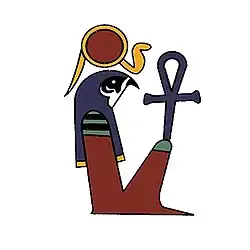
Le hiéroglyphe égyptien C2 (Rê-Horakhty assis) est classifié dans la section C « Divinités anthropomorphes » de la liste de Gardiner ; il y est noté C2.
Représentation
Il représente le dieu Rê sous forme hiéracocéphale (falco peregrinus) Rê-Horakhty assis, portant la croix ânkh (hiéroglyphe S34) dans ses mains et le disque solaire sur sa tête. Il est translittéré Rˁ.
Utilisation
| C'est un idéogramme ou déterminatif du terme Rˁ |
|
« Rê »[1]. |


Notes et références
Bibliographie
- Alan Henderson Gardiner, Egyptian Grammar: Being an Introduction to the Study of Hieroglyphs, [détail des éditions] (lire en ligne).
- Pierre Grandet et Bernard Mathieu, Cours d'égyptien hiéroglyphique [détail des éditions].
- Johann Peter Adolf Erman et Hermann Grapow, Wörterbuch der ägyptischen Sprache, vol. II (lire en ligne), p. 401.
 Portail de l’Égypte antique